

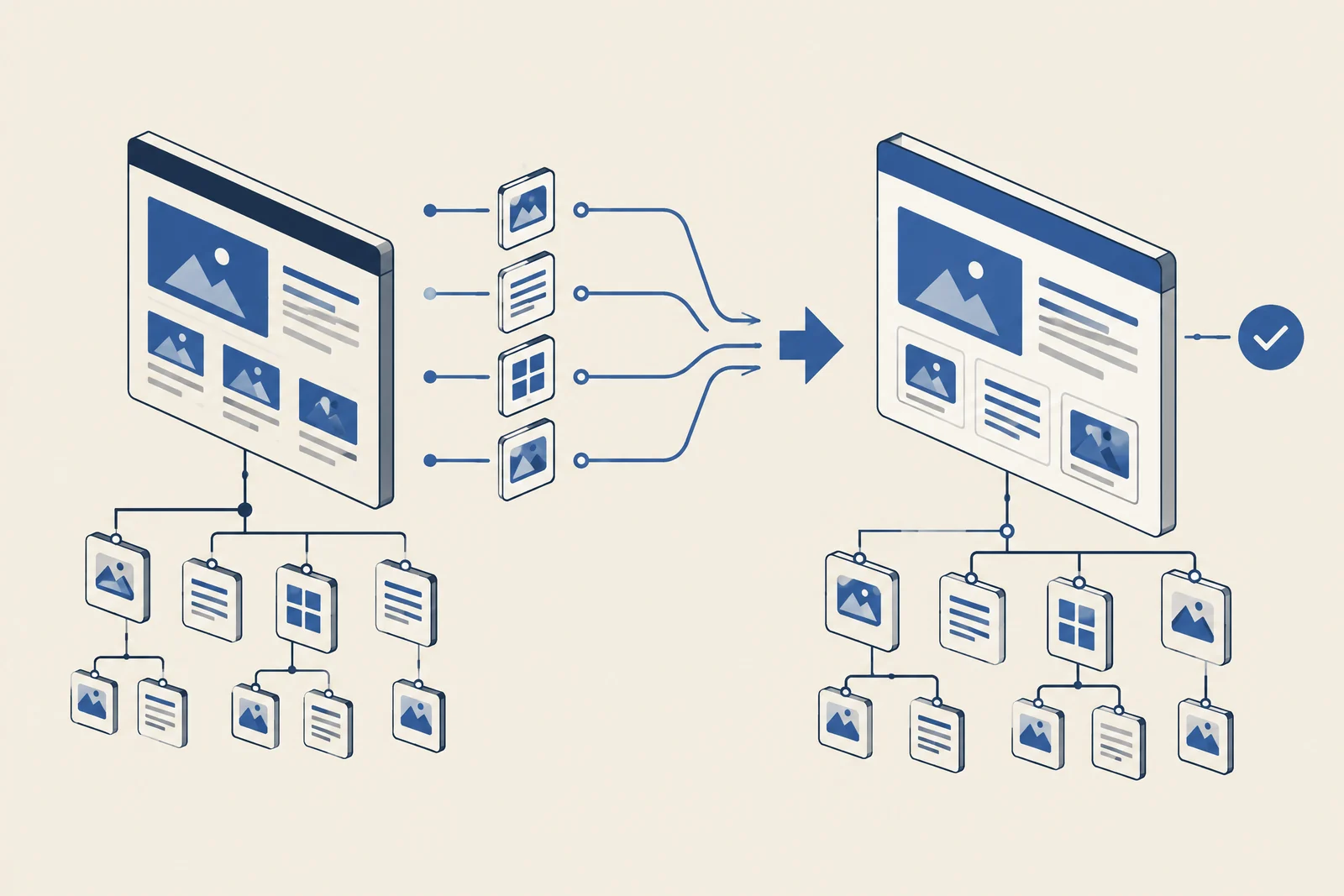
A migration is an information move, not just a redesign
A new site changes more than the visual system. It can change URL structure, internal links, templates, metadata, page speed, language handling, and the way search engines understand the relationship between pages. Treating it as a design launch leaves too much to chance.
The useful question is not whether every old URL should survive unchanged. It is whether every important search intent, internal link path, and business-critical page has a deliberate destination on the new site.
Create the inventory before development locks in
Before a build is final, export the existing URLs and mark the pages that currently earn traffic, links, conversions, or internal importance. Add proposed destinations, owners, and a status for each decision. This turns redirects into a planning exercise instead of an emergency task.
- Map high-value legacy URLs to the most relevant new URL, one by one.
- Record pages that should be consolidated, retired, or kept because they serve a distinct search intent.
- Protect titles, headings, copy, and internal links on pages that already perform until there is evidence for a change.
- Agree a staging review that checks crawlability, rendering, canonical tags, language alternates, and noindex directives before launch.
Treat redirects and internal links as one system
A redirect is not a substitute for a clean new architecture. Use direct server-side redirects for moved pages, then update internal navigation, content links, canonicals, hreflang tags, and sitemap URLs to point at the final destination. A visitor and a crawler should not have to pass through unnecessary hops.
After launch, crawl the live site and compare the response codes, canonical URLs, and internal links against the migration map. The best time to discover a loop, a missing page, or an accidental noindex tag is before search traffic has had time to fall.
Keep a short post-launch watch list
Search Console makes the first weeks more manageable. Check indexing and URL Inspection for representative pages, confirm that the sitemap is processed, and monitor the pages and queries that mattered before the move. Give Google time to recrawl, but do not wait to fix clear technical errors.
The migration is complete when the new site is technically stable and the team can explain the performance movement. It is not complete when the homepage looks finished.